F.A.Q. by UNIVERSITY FIREWOOD

Firewood is a renewable resource, provided the consumption rate is controlled to sustainable levels. Proper forestry practices applied to firewood allow the usage of a carbon-neutral, or even carbon-negative, energy source, since the carbon dioxide released by the burning of the firewood was previously absorbed from the ambient atmosphere through photosynthesis. As a result, firewood can be considered to be a form of solar energy.
Types of Wood...
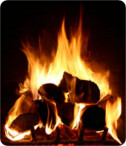
Firewood can be either Hardwood (Deciduous Trees such as Apple, Birch, Cherry, Maple, Oak or Walnut) or Softwood (Conifers
such as Fir, Hemlock, Pine or Spruce). Hardwoods burn much longer and tend to have a far higher heating value than softwoods. The
densest Hardwoods--Beech, certain Maples, Hickory and Oak--produce the greatest heat, with an output of approximately 30% more BTU's
(the amount of heat needed to raise the temperature of 1lb of water 1° F) than other Hardwoods
and about 50% more BTU's than most Softwoods.
The Importance of Seasoning...
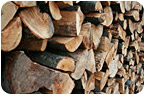
Whichever type of Firewood you choose, make certain that it has been properly seasoned. If you burn Wet or 'green'
wood, you will use up thousands of BTUs heating up the moisture in the wood before it even begins to burn. Not only will this
result in heat loss; you will also run the risk of having your chimney coated with "creosote". A buildup
of creosote in your chimney is dangerous, since it can ignite and cause an intense fire in the chimney as it burns itself
off. This will necessitate more frequent chimney cleanings and may cause exensive damage to your chimney. Many homes have
burned to the ground as a result of creosete chimney fires. In short, then, buying green wood for immediate use is not
a good value - even if it is less expensive than a cord of seasoned wood.
| FIREWOOD GUIDE - BTU RATING CHART | ||||
|---|---|---|---|---|
| Type of Wood |
Heat Output |
Heavy Smoke |
BTU's per Cord |
Rating |
| Hard Maple |
High |
No |
29.7 |
Excellent |
| Red Oak |
High |
No |
21.7 |
Excellent |
| White Oak |
High |
No |
26.5 |
Excellent |
| Beech |
High |
No |
21.8 |
Excellent |
| Birch |
High |
No |
21.3 |
Excellent |
| Apple |
Medium |
No |
19.6 |
Good |
| Cherry |
Medium |
No |
18.5 |
Good |
| Ash |
High |
No |
25.9 |
Excellent |
| Walnut |
Medium |
No |
20.3 |
Good |
| Elm |
Medium |
Medium |
23.8 |
Fair |